
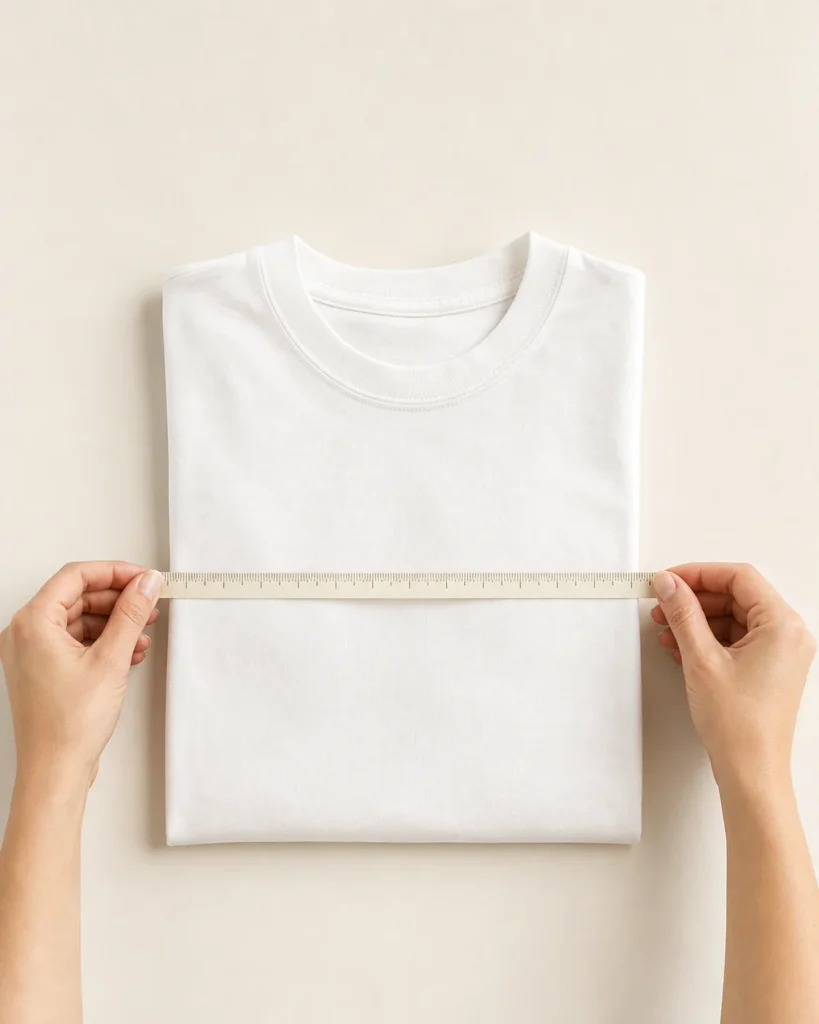
If you've ever ordered a "size 10-12" tee and had it arrive either swimming on her or stopping three inches above where it should, you've already discovered the problem with age-based sizing: it doesn't actually measure anything. It's a guess dressed up as a size.
Here's the method we use ourselves, and the one we'd recommend regardless of where you're buying from.
Why age charts fail in the 9â?”14 range specifically
Two girls the same age and height routinely wear two different sizes. Growth in the tween years isn't linear or uniform â?” some girls are proportionally longer in the torso, some are broader through the shoulders, and none of that shows up on a chart that only asks for age. A size chart built around "age 11" is really just an average of a lot of very different 11-year-olds, and averages fit nobody exactly.
The fix isn't a better chart. It's skipping the chart entirely.
The 3-measurement method
Pick the tee in her closet she reaches for most â?” the one she says is comfortable, that she wears without being asked twice. Lay it flat on a hard surface, smooth out the wrinkles, and measure these three things with a soft tape measure or a ruler:
1. Chest width â?” measure straight across the shirt, from one armpit seam to the other, with the shirt laid flat. Multiply by 2 for the full chest circumference if you're comparing to a "chest measurement" listed in inches around the body.
2. Total length â?” from the top of the collar (where it meets the shoulder seam) straight down to the bottom hem.
3. Sleeve length â?” from the shoulder seam to the end of the sleeve.
Write the three numbers down. That's it â?” that's the profile of the fit she already likes.
What to do with the numbers
Any product page that publishes real garment measurements (chest and length, in inches and centimeters) lets you compare directly: if a size M is closer to her favorite tee's numbers than a size S or L, that's the one to order. No conversion, no guessing which side of a size range she falls on.
If a store doesn't publish real measurements â?” only an age range or a generic S/M/L with no numbers attached â?” that's worth treating as a yellow flag. It usually means you're back to guessing.
A few things that trip people up
Don't measure her body directly if you can avoid it. A tape measure around a squirming, self-conscious tween is a worse data source than a flat garment she already approved with her feet (or in this case, her willingness to wear it repeatedly). The clothes-based method also sidesteps a genuinely sensitive moment for a lot of girls this age â?” no standing still for measurements, no conversation about body size at all.
Account for shrinkage. Cotton-rich tees can shrink somewhat after the first wash. If a size feels borderline, sizing up slightly is usually the safer call, especially for a tee that'll get worn and washed dozens of times.
When in doubt, go with room to grow, not room to swim. A little extra length and a slightly looser chest reads as "relaxed fit, on purpose." A tee that's actually too big just reads as too big.
Our own approach
We publish exact garment measurements — chest and length, in inches and centimeters — on every product we sell, specifically so this method works without any extra math, and we'll add sleeve once product #1 ships and we can measure real samples. See our full Size & Fit Guide for the complete method, including wash-care notes and what to do if a size still doesn't land right after it arrives.