
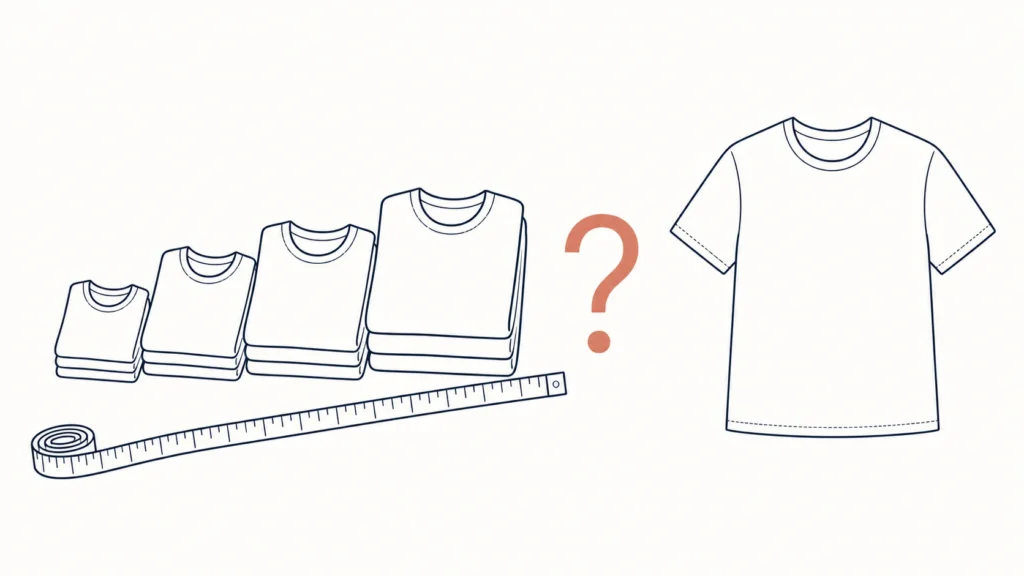
There’s a specific moment a lot of parents run into: a girl outgrows the top of the girls’ size range — usually 14 or 16 — and the next logical step isn’t obvious. Juniors sizing exists, women’s sizing exists, but neither one picks up cleanly where girls’ sizing left off. It’s a common enough shopping frustration that it’s worth understanding why it happens, not just working around it order by order.
Why girls’ 14/16 and an adult XS aren’t the same shirt
Girls’ sizing is built around a straighter, shorter-torso frame — proportions that fit a body that hasn’t yet gone through the growth patterns of the teen years. Juniors and women’s sizing are built around a completely different set of assumptions: longer limbs, a different hip-to-waist ratio, more room through the bust. So even when a juniors XS or a women’s XXS looks like the “next size up” on a label, the actual cut underneath rarely matches what fit a size 14/16 well. The sleeves run long, the rise sits differently, the shoulders are wider than they need to be. Same general size category, different garment entirely.
Why a size chart alone won’t fix this
The instinct is to find a conversion chart and match numbers. The problem is that the 9–14 age range is exactly when kids grow at the least predictable rate — not just taller, but at different rates through the torso, shoulders, and hips depending on the individual kid. Two girls the same age and height can genuinely need two different sizes, in two different systems, for two different reasons. A chart that just maps “girls 14 = juniors XS” glosses over all of that — it’s a starting guess at best, not an answer.
The method that skips the chart entirely
The more reliable approach doesn’t start with a size label at all. Take a tee she already owns and actually likes the fit of, lay it flat, and measure it directly — chest width and body length, at minimum. Compare those real numbers to whatever you’re considering buying next, regardless of what size it’s labeled. This works the same way whether you’re shopping girls’, juniors’, women’s, or anything in between, because it sidesteps the label mismatch completely. It’s the exact method we walk through in the Size & Fit Guide and in How to Measure a Tee She Already Owns.
What this means when you’re shopping outside our own sizing
This isn’t a pitch to only buy from us — it’s genuinely useful anywhere. A few things worth doing regardless of the brand:
Why we build our own tees around this
We publish real chest and length measurements for every size we make, specifically because “age 9–14” isn’t a fit — it’s a marketing shortcut.
Common questions
Not reliably. The numbers can look adjacent, but girls’ sizing is cut for a straighter, shorter-torso frame, while women’s sizing assumes longer limbs and a different hip-to-waist ratio. Treat any specific “14 = XXS” claim as a rough starting guess, not a guarantee, and compare real measurements before buying.
There’s no single reliable answer, because it depends on the specific brand’s cut in both girls’ and juniors’/women’s sizing. The more reliable approach is measuring a tee she already owns and likes the fit of, then comparing that directly to the garment measurements of whatever you’re considering — regardless of which sizing system it’s labeled in.
Because they’re built around different body proportions, not just different scales of the same shape. Girls’ sizing is designed for pre-teen proportions; juniors’ and women’s sizing assumes the longer limbs and different bust/hip allowance that come with later development. A shared number on the label doesn’t mean a shared pattern underneath it.
Read the full reasoning in Our Approach, or go straight to the Size & Fit Guide before your next order — with us or anyone else.