
A print that cracks after a handful of washes is one of the most common tween-tee complaints, second only to fit. The two most common ways of printing a graphic onto a shirt work differently enough that it’s worth understanding both before assuming “the design looks cool” is the whole story.
What screen printing actually is
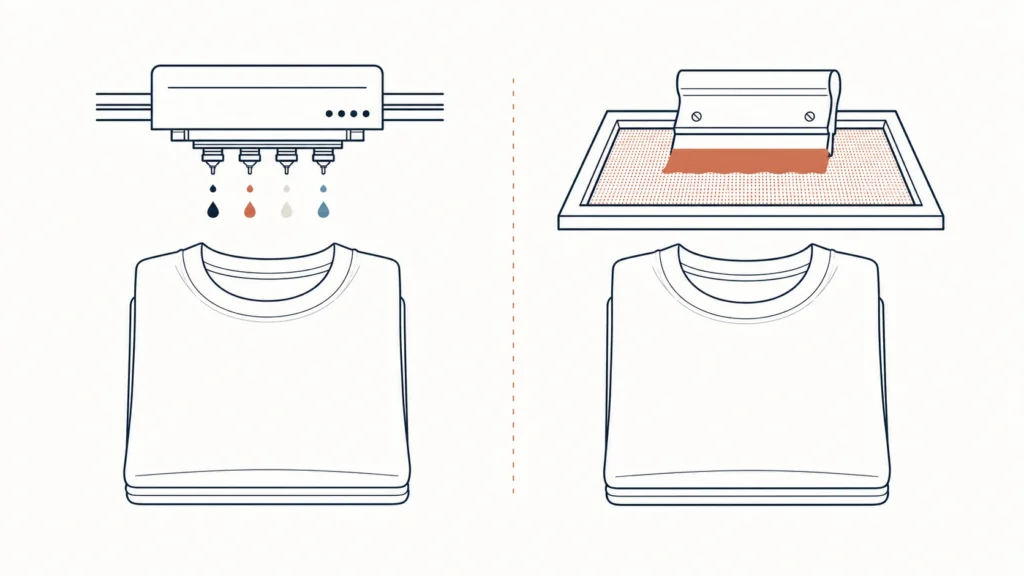
Screen printing pushes ink through a stencil (screen) onto the fabric, one layer of ink per color, then cures it with heat. It’s been the standard method for decades because it holds up well at high volume — a printer running 500 identical shirts can do it efficiently, and the ink lays down thick enough to survive a lot of washing. The tradeoff is setup: each color needs its own screen, so it’s cost-effective mainly at bulk quantities and gets expensive fast for small runs or one-off designs.
What DTG actually is
Direct-to-garment (DTG) printing works more like an inkjet printer, but for fabric — the design prints directly onto the shirt with textile ink, no screens or per-color setup required. That makes it well suited to small-batch or made-to-order production, since one shirt can carry a completely different design from the one before it without added cost. The print sits differently than screen printing too: generally thinner and softer to the touch when done correctly, but more sensitive to how it’s applied and cared for than a thick screen-printed layer.
Where each one tends to fail
Neither method is failure-proof. Screen prints crack or peel most often when the ink goes on too thick or cures at the wrong temperature — the print becomes a rigid layer sitting on flexible fabric, and something eventually gives. DTG prints fail differently: too little ink saturation lets the fabric’s fibers show through and the color fades faster; the wrong wash routine can affect the print sooner than it would a thicker screen-printed layer. In both cases, the actual finishing process matters more than which method was used — a well-executed print in either method outlasts a poorly-executed one in the other.
Why we use DTG
We chose DTG for the same reason most made-to-order kids’ apparel does: nothing gets printed until an order actually exists, so there’s no unsold bulk inventory sitting in a warehouse, and every design ships in the actual colors and sizes ordered instead of whatever pre-printed stock happens to be on the shelf. It’s also what makes a full four-collection catalog possible without printing hundreds of shirts nobody’s bought yet.
What we can tell you right now, and what we can’t yet
Here’s the honest version: we haven’t published a durability claim for our own prints, on purpose. We’d rather test a real decorated sample and report back something specific than promise “prints that last” before anyone’s actually worn one through a full wash cycle. What we can tell you today is the method — DTG, applied to a cotton-rich Bella + Canvas 3001Y youth tee — and the one care habit that gives any DTG print its best shot: wash cold, inside out.
Common questions
Neither is universally better — they’re suited to different production models. Screen printing holds up well at high volume and low cost per unit once you’re printing hundreds of the same design; DTG is better suited to made-to-order or small-batch production, where every shirt might carry a different design. The failure risk in both cases comes down to execution quality more than the method itself.
A well-applied DTG print sits thinner and softer against the fabric than a screen print, which lays down a thicker, more rigid layer of ink. That’s part of why DTG can feel more like part of the shirt rather than something printed on top of it — but it also means DTG prints are more sensitive to how they’re washed and dried.
They fail differently. Screen prints usually crack or peel when the ink layer is too thick or cured at the wrong temperature. DTG prints are more likely to fade if the ink saturation was too light, or to wear down faster under high heat and repeated washing without care. See Stop the Peel: How to Wash a Graphic Tee for the specific wash routine that protects either type of print.
Read our full approach for how we’re deciding what goes into the collection, or check the FAQ for where we’ll post real durability notes once we have them.